How to Choose a Good Dog Food Bag: A Buyer’s Guide to Materials, Sizes, and Bag Styles

1.How to Choose a Good Dog Food Bag-banner

Choosing the right dog food packaging bag is not only about appearance. For pet food brands, importers, and contract manufacturers, the right packaging must protect freshness, support transportation, control cost, and perform well on the shelf. In most cases, the best dog food bag depends on five key factors: product weight, shelf-life target, barrier requirement, bag style, and branding needs.This guide explains how to choose dog food packaging bags based on materials, bag types, moisture protection, size range, and cost efficiency, so buyers can make faster and more accurate sourcing decisions.

Quick Answer: What Is the Best Packaging for Dog Food?

The best dog food packaging bag depends on the product size and protection requirement. For small retail packs, a stand up pouch with transparent or metallized material is often a practical option. For medium packs, stand up pouches or flat bottom pouches are commonly used, with metallized or foil structures depending on shelf-life goals. For large packs, flat bottom pouches or side gusset bags with aluminum foil structures are usually preferred because they offer stronger barrier protection and better durability during transportation.

What Makes a Good Dog Food Packaging Bag?

A good dog food packaging bag should do more than hold the product. It should help preserve freshness, prevent moisture ingress, reduce oxygen exposure, protect aroma, and make daily use more convenient for pet owners. For most dog food applications, buyers usually look for the following features:

  • Strong moisture and oxygen barrier
  • Reliable sealing strength
  • Durable structure for shipping and storage
  • Resealable zipper for repeated opening and closing
  • Attractive printing for shelf impact
  • A bag shape that matches the filling weight and retail positioning

For premium pet food brands, packaging also affects shelf presence and consumer trust. A well-designed bag can improve both product protection and brand image.

Main Materials Used for Dog Food Packaging Bags

2.dog food bag Aluminum Foil Structures

1. Aluminum Foil Structures

Aluminum foil structures are usually recommended for dog food products that require stronger protection against moisture, oxygen, and light. They offer a high barrier level and are often used for premium formulas, export shipments, and larger pack sizes.

Best for:

  • Dog food above 2.5 kg
  • Products with longer shelf-life requirements
  • Premium pet food with higher freshness expectations
  • Long-distance shipping or humid storage environments

Typical structures: PET / AL / PE, PET / AL / NY / PE

2. Metallized Film Structures

Metallized film structures, such as VMPET or MPET laminations, are often used when buyers want a balance between cost and barrier performance. They provide a metallic look and decent protection while remaining more cost-effective than full foil structures.

Best for:

  • Dog food below 2.5 kg
  • Mid-range retail products
  • Projects balancing cost, appearance, and barrier needs
  • Applications where moderate-to-high protection is sufficient

Typical structures: PET / VMPET / PE, PET / MPET / PE

3. Transparent Structures

Transparent structures are commonly used for small retail packs when product visibility is important. They are suitable for brands that want consumers to see the kibble or include a clear window design. However, transparent structures usually provide lower barrier performance than foil or metallized options.

Best for:

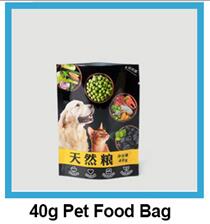
  • Small packs such as 40g, 100g, 500g, 1kg, or 2kg
  • Trial packs and sample packs
  • Products with faster turnover
  • Brands that value visible product presentation

Typical structures: PET / PE, PET / NY / PE, transparent window + high-barrier laminated structure

Which Material Is Better for Moisture Protection?

If moisture resistance is a top priority, the general ranking is:

  1. Aluminum foil
  2. Metallized film
  3. Transparent structure

Moisture protection matters because it directly affects dog food texture, aroma retention, and shelf stability. If your product will be sold in humid climates, exported internationally, or stored for a longer period, a higher-barrier structure is usually the safer option.

Common Bag Types for Dog Food Packaging

3.Common Bag Types for Dog Food Packaging

Flat Bottom Pouch

Flat bottom pouches are one of the most popular choices for dog food packaging. They stand well on the shelf, offer a premium appearance, and provide large printable surfaces for branding and product information.

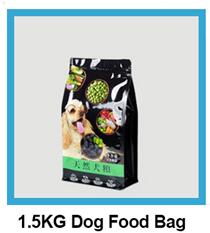
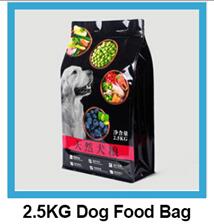
Recommended for: 1.5 kg to 10 kg dog food, premium retail presentation, and larger-volume products.

Stand Up Pouch

Stand up pouches are practical and cost-efficient for smaller retail packs. They are lightweight, easy to display, and commonly paired with zipper closures for convenience.

Recommended for: 40g to 2kg dog food, sample packs, and standard retail applications.

Side Gusset Bag

Side gusset bags are often used for larger-volume packaging where storage efficiency and filling capacity matter. They are suitable for bulk or family-size formats.

Recommended for: larger dog food packaging and efficient transport packing.

Zipper Closure

A zipper is not a separate bag type, but it is an important functional feature for dog food packaging. It can be added to stand up pouches, flat bottom pouches, and other structures to improve convenience and support repeated use after opening.

Recommended Packaging by Product Weight

Small Packs (40g–500g)

  • Recommended bag type: Stand up pouch
  • Recommended structure: Transparent or metallized
  • Recommended use: Samples, trial packs, small retail packs

Medium Packs (1kg–2.5kg)

  • Recommended bag type: Stand up pouch or flat bottom pouch
  • Recommended structure: Metallized film or foil depending on shelf-life target
  • Recommended use: Mainstream retail products, e-commerce packs

Large Packs (3kg–10kg)

  • Recommended bag type: Flat bottom pouch or side gusset bag
  • Recommended structure: Aluminum foil structure
  • Recommended use: Family-size packs, premium dry kibble, export packaging

4.Flat Bottom Pouch

Dog Food Packaging Comparison Table

5.Dog Food Packaging Comparison Table

Packaging Option Best For Barrier Level Cost Level Shelf Impact
Aluminum Foil Bag 2.5kg+ dog food, longer shelf life, export shipment High High Premium
Metallized Bag Small to medium retail packs, balanced solution Medium-High Medium Strong
Transparent Bag Small packs, trial packs, visible product display Medium-Low Low Good

Common Dog Food Bag Sizes

Dog food bag size depends on filling weight, kibble density, bag style, and whether features such as zipper, handle, or special finish are required. Below are common reference sizes used in the market:

Filling Weight Reference Size
40g 10 × 14 + 5 cm
500g 14 × 25.5 + 8 cm
1kg 20 × 30 + 8.5 cm
1.5kg 21 × 35 + 10 cm
2.5kg 26 × 41 + 11 cm
5kg 30 × 58 + 9 cm
10kg 36 × 76 + 12 cm

These are reference sizes only. In actual production, the final bag dimensions should be confirmed according to your product density, filling method, and packaging features.

How Material Choice Affects Cost

If bag size, thickness, and bag style remain similar, material choice will strongly affect cost. In general, aluminum foil bags are the most expensive, metallized bags are more cost-effective, and transparent bags are usually the most economical. However, buyers should evaluate packaging cost together with shelf life, storage environment, shipping distance, and product positioning. A lower unit price is not always the best option if it creates freshness or transport risks.

How to Choose the Right Dog Food Bag for Your Brand

Before asking a supplier for a quotation, buyers should usually confirm the following points:

  1. What is the filling weight per bag?
  2. What shelf life do you want to achieve?
  3. Does your product require high moisture and oxygen barrier?
  4. Do you want consumers to see the product inside?
  5. Which bag style fits your brand image and shelf strategy?
  6. Do you need zipper, tear notch, matte finish, or handle?
  7. Will the product be sold locally or exported internationally?

Once these points are clear, it becomes much easier to choose the right material structure and receive a more accurate quote.

What Information Should You Send to a Dog Food Bag Supplier?

To speed up sourcing and quotation, it helps to prepare the following information before contacting a packaging supplier:

  • Product type
  • Filling weight
  • Target bag size
  • Target shelf life
  • Material preference
  • Bag style
  • Zipper or closure requirement
  • Printing artwork or design draft
  • Estimated order quantity

FAQ

What is the best material for dog food packaging bags?

There is no single best material for every dog food product. Aluminum foil is usually best for high barrier requirements and larger packs. Metallized film is a balanced option for cost and protection. Transparent structures are suitable for smaller packs where product visibility matters.

Are flat bottom pouches good for dog food?

Yes. Flat bottom pouches are one of the most popular options for dog food because they stand well, look premium, and work well for medium and large packaging sizes.

Can transparent dog food bags protect freshness?

They can work for some small-pack applications, but they usually do not provide the same barrier level as foil or metallized structures. For longer shelf life or humid environments, higher-barrier materials are generally preferred.

Do dog food bags need zippers?

For many retail products, yes. A zipper improves convenience for pet owners and helps maintain freshness after opening, especially for small and medium pack sizes.

What bag structure is recommended for 5kg dog food?

For 5kg dog food, a flat bottom pouch or side gusset bag with a higher-barrier laminated structure is often recommended. If shelf life and moisture protection are important, an aluminum foil structure is usually a strong option.

Can dog food packaging bags be customized?

Yes. Dog food packaging bags can usually be customized in size, material structure, thickness, bag type, zipper, finish, and printing design according to your project requirements.

Final Thoughts

A good dog food packaging bag should match your product, market, and brand strategy. For smaller retail packs, stand up pouches with transparent or metallized structures may be sufficient. For larger packs or higher barrier requirements, flat bottom pouches with foil-based structures are often a better choice.

If you are sourcing custom dog food packaging, the most efficient way is to send your target bag size, filling weight, shelf-life requirement, and preferred bag type to your packaging supplier. This helps them recommend the right structure and provide a more accurate quotation.

6.CTA

Need Custom Dog Food Packaging Bags for Your Brand?

Send us your product weight, target shelf life, preferred bag style, and artwork requirements. We can help you choose the right material structure, bag size, and printing solution for your dog food packaging project.

Contact us today for customized packaging advice and a fast quotation.


Post time: Dec-05-2017